Next revision of ISO 9001 – The Evolution of Quality Management: ISO 9001:2026
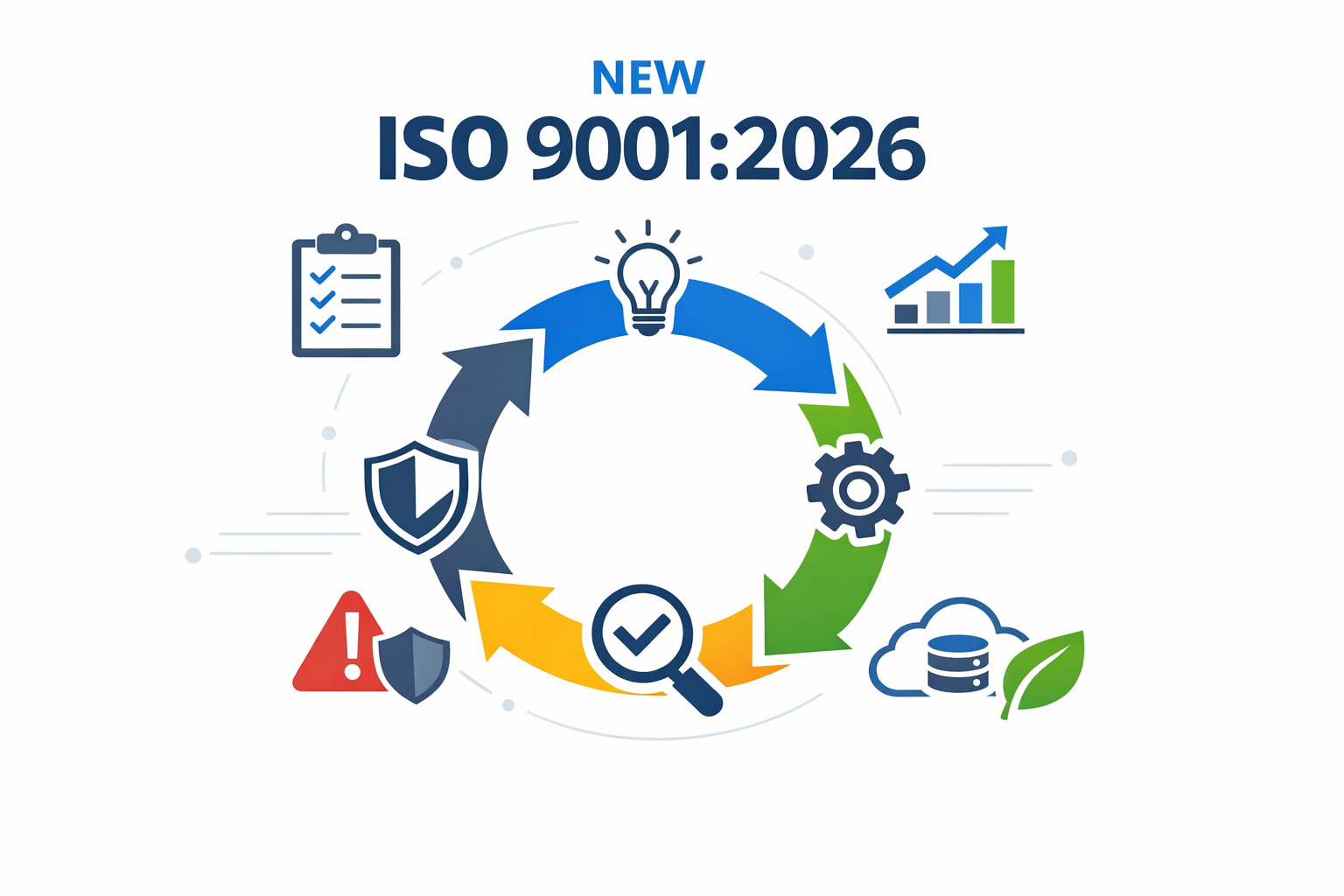
The International Organization for Standardization (ISO) is preparing the next revision of ISO 9001, the world’s most widely used Quality Management System (QMS) standard. The upcoming ISO 9001:2026 revision, expected to be published in September 2026, reflects today’s complex business environment, digital transformation, sustainability expectations, and growing attention to ethics and organizational resilience.
Since its last major revision in 2015, ISO 9001 has helped organizations improve customer satisfaction, strengthen operational efficiency, and establish structured processes for continual improvement. The 2026 revision is expected to remain aligned with the standard’s core philosophy while clarifying and strengthening key areas to reflect the evolving business environment.
Why ISO 9001 Is Being Revised
Since the publication of ISO 9001:2015, organizations have faced global disruptions, rapid digitalization, increased stakeholder scrutiny, and heightened expectations around sustainability and ethical conduct. ISO 9001:2026 is intended to respond to these realities primarily by strengthening and clarifying existing requirements rather than introducing an entirely new model.
Key focus areas include:
- Reinforcing leadership responsibility and quality culture
- Integrating resilience, climate change, and sustainability considerations
- Acknowledging the role of digital technologies and data integrity in modern quality management
- Improving clarity, guidance, and alignment with other ISO management system standards
Key Changes from ISO 9001:2015 to ISO 9001:2026
1. Stronger Emphasis on Leadership and Ethical Quality Culture
One of the most notable updates is an increased focus on leadership accountability and ethical behavior.
Top management will be expected not only to support the QMS, but also to actively foster a quality culture and promote ethical decision-making across the organization. Quality objectives should align with organizational values and be communicated consistently.
This reinforces that quality management is not merely a compliance activity, but a shared responsibility that supports transparency, trust, and long-term performance.
2. Integration of Sustainability and Climate Considerations
ISO 9001:2026 is expected to include stronger references to sustainability and environmental responsibility, including consideration of climate-related issues when understanding the organization and planning strategically.
Organizations will likely need to evaluate more systematically how environmental and social factors affect their operations, risks, and opportunities, aligning quality management with broader ESG (Environmental, Social, and Governance) principles.
3. Improved Risk and Opportunity Management
Risk-based thinking is already part of ISO 9001:2015, but the revision is expected to provide clearer guidance on identifying, assessing, and addressing both risks and opportunities.
Organizations will be encouraged to:
- Identify disruptions earlier
- Strengthen proactive planning
- Capture opportunities for improvement and innovation
This approach supports greater organizational resilience and adaptability in dynamic markets.
4. Digitalization and Organizational Resilience
The revised standard recognizes the growing role of digital technologies in quality management.
ISO 9001:2026 is expected to place more emphasis on:
- Data integrity and information management
- Automation and digital tools
- Cybersecurity considerations
- Business continuity and contingency planning
These elements help organizations maintain operational stability even during disruptions.
5. Expanded Guidance Through Annex A
To improve clarity and implementation, the 2026 version is expected to include expanded guidance in Annex A covering clauses 4–10.
This additional guidance is intended to:
- Provide clearer explanations of requirements
- Offer practical examples
- Support consistent interpretation across different industries
The aim is to reduce ambiguity and improve usability of the standard.
6. Updated Terms, Definitions, and Structure
Another refinement is the inclusion of quality management terms and definitions within the standard, reducing reliance on external references.
In addition, ISO 9001:2026 is expected to remain aligned with ISO’s Harmonized Structure (HS), supporting compatibility with other management system standards (e.g., environmental, information security, and occupational health and safety).
This alignment makes integrated management systems easier to implement and maintain.
What Organizations Should Do Now
For organizations already certified to ISO 9001:2015, the transition to ISO 9001:2026 is expected to be evolutionary rather than disruptive.
Most organizations will likely need to:
- Review the organizational context and stakeholder expectations
- Strengthen leadership involvement and quality culture
- Integrate sustainability and climate considerations into planning
- Evaluate digital risks and data management practices
- Update documentation and processes where needed
Organizations that already embrace continual improvement, digital tools, and sustainability principles will likely find the transition smoother.
Conclusion
ISO 9001:2026 represents an evolutionary step that aims to strengthen quality management by aligning it with today’s business realities. By emphasizing ethical leadership, resilience, digitalization, and sustainability while maintaining the familiar structure of ISO 9001 the revised standard supports organizations in building robust, future-ready quality management systems.
Adopting ISO 9001:2026 is not only about compliance; it is an opportunity to reinforce trust, improve performance, and demonstrate a genuine commitment to quality and continual improvement.
In the accompanying presentation, we summarize the key updates and practical implications of ISO 9001:2026 to help organizations understand the expected changes and prepare for the transition.